Investigation into the overlooked suicides in Europe
Disregarded distress, inadequate care and disciplinary units
Source: StreetPress
< image ©Léa Guiraud - Kiblind.
On 29 November 2024, Valérie’s life fell apart. Her 24-year-old son Morgan was found hanged in his cell at Fresnes Prison (France). Dressed in black, with a steady gaze, she describes Morgan as a “sweet kid who spent his afternoons at the football pitch, before shutting himself away in his bedroom after his older brother’s suicide in 2019”. During the nine months he spent in remand detention while awaiting a date for his trial, Valérie saw her son’s health fade away day after day: “He didn’t leave his cell. He got so thin and was dulled by sleeping pills.”
Morgan made two suicide attempts, in March and April 2024, before being transferred on 1 August to the specially designed unit of Fresnes – an isolated area reserved for people who require particular attention. On 30 October 2024, the day of his release, he made a third attempt: “He swallowed an entire blister pack of paracetamol.” Back in the standard area with a “support cellmate”, he requested to be placed in a cell alone, but his mother did not know why. “The telephone was not working. The fact that he was unable to reach me definitely pushed him to do what he did”, insists Valérie. “The guards knew that he wasn’t doing well, and they did nothing”, she adds accusingly. She lodged a complaint against persons unknown for “manslaughter” and “failure to assist a person in danger”. “I refuse to grieve – I’m angry”.
Miles away, in the semi-open prison of Jilava, just south of Bucharest in Romania, 42-year-old Andrei, who has spent half of his life in Romanian prisons, had to detach his cellmate from a pipe in 2020, where he had hanged himself with a belt around his neck: “The guards weren’t there.” In Hungary, one incarcerated person recently died by suicide at the Forensic Psychiatric and Mental Institution in Budapest – the facility where people experiencing extreme psychological distress are sent – despite being under constant video surveillance. “The guard didn’t notice”, reports Gabor Gyozo, a lawyer at the Hungarian Helsinki Committee.
According to legal precedent from the European Court of Human Rights, each death in prison is considered suspicious and must undergo an independent judicial investigation, including for suicides. Some families of people who have died by suicide behind bars have denounced the shortcomings that led to these deaths that occurred while these individuals were under the responsibility of the state.
StreetPress, in partnership with Prison Insider, travelled to a few European countries with high mortality rates in detention – France, Romania and Hungary – to investigate suicides. No reliable, official figures exist. When contacted, the relevant Ministries did not wish to comment. The silence faced by StreetPress revealed the extent of the omerta around these deaths in prison.
Investigation into deaths in European prisons
This investigation is divided into two parts: the first explores the suicides in detention linked to the lack of psychological care and the imprisonment conditions; the second focuses on suspicious deaths, which have more to do with the institutional violence in the prisons of France, Romania and Hungary.
This article was produced by StreetPress, in collaboration with Prison Insider, as part of the Unmasking truth project, with financial support from the European Media and Information Fund.
In 2023 in France, 148 incarcerated individuals died by suicide.
“My spirit can’t go through the window.”
At the Rahova penitentiary centre (Romania), there are 1,500 spaces and just one psychiatrist.
Inadequate psychological care
“My son has suicidal thoughts. I’m afraid he’ll act on them”, says Safia worriedly. Her 34-year-old son Balazs is incarcerated at Csenger, a Hungarian high-security facility on the border with Romania, which opened in the spring, where he has no one to confide in about his distress. He has only been able to speak to a psychologist twice, despite his numerous requests – and only via video call. Lili Kramer, a criminologist at the Hungarian Helsinki Committee (HCC), says this situation is widespread: “In the average prison, two to five psychologists must look after around 600 incarcerated individuals”. From 1995 to 2017, the HHC conducted a monitoring programme on prison conditions, before the government unilaterally terminated the cooperation agreements. The Hungarian prison service commented to StreetPress: “On their arrival in prison, incarcerated people undergo a thorough medical and psychological examination. Treatment is always personalised and provided by psychologists employed by the facilities.”
At the Rahova penitentiary centre, about ten kilometres from Bucharest (Romania), there are 1,500 spaces, 121% overcrowding and just one psychiatrist. “She also handles paperwork”, notes Georgiana Gheorghe, Executive Director of the Association for the Defence of Human Rights in Romania – one of the few Romanian organisations that monitors the respect for fundamental rights in prisons. At the facility in Fleury-Mérogis (France), which holds 4,808 incarcerated individuals, the regional medical and psychological service only has 18 spaces for men and nine for women. They are constantly occupied.
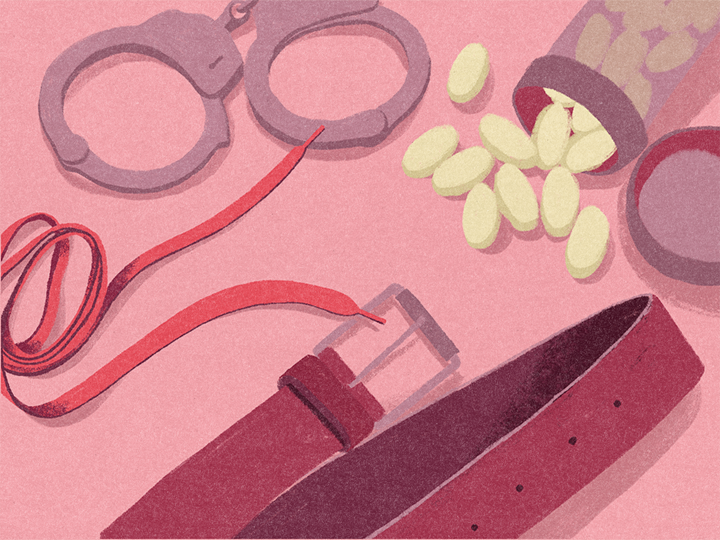
In Romania, no specific training on the subject is provided to prison staff.
Disregarded distress
Pascale Giravalli, president of an organisation dedicated to the psychiatric sectors in the carceral environment (Association des Secteurs de Psychiatrie en Milieu Pénitentiaire) in France, notes that there are other challenges besides insufficient capacities: “The medical staff face care access conditions that have only deteriorated with the increase in security and enforcement measures within prisons.” The Hungarian lawyer Batki Pal says that one of his clients was disciplined with eight days of solitary confinement. During that time, his only interactions were with the officer who opened his door every 24 hours to ask him: “Suicide?”
“Death is still a taboo in our line of work. It is even absent from our training”, reports Wilfried Fonck, the national secretary of the French penitentiary union UFAP-UNSa Justice. In the facility in Fleury-Mérogis, in France, the surveillance officers in the disciplinary unit only receive two days of training on suicide prevention. “The signs become recognisable with experience. Sometimes, talking about suicide is also a way to get out of prison. We have to separate ‘the truth from the lies’”, remarks one officer, further mentioning the risk of “blackmail”, although this risk has not been proven.
In Romania, no specific training on the subject is provided to prison staff. “Suicide is not really an issue in our case”, the vice president of the primary Romanian penitentiary union, Adrian Neagoe, says dismissively. In the 78-page activity report published by the Romanian prison service for 2024, a review by StreetPress revealed only one brief mention of suicide.
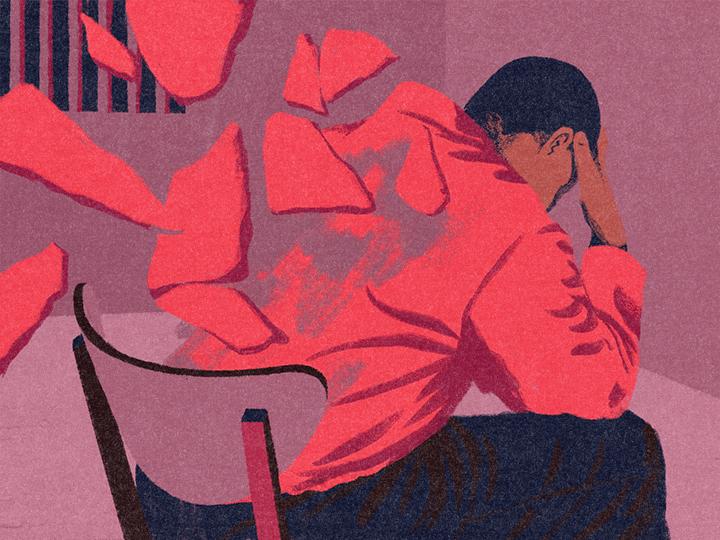
“We tend to act as though these cases are rare or exceptional, but they are part of everyday life in prison.”
What prison is not
++
Who makes the rules in prison?
The public has numerous preconceived assertions surrounding prison. One in particular comes up often: that incarcerated people call the shots on the inside. Does this perception reflect the reality in Europe? Read on to find the answer in the last piece of our fact-checking series.